You keep a close eye on your rent and your payroll, but do you know your bandwidth? In 2026, bandwidth is the oxygen of your business. If your connection is thin, your productivity suffocates. It is the hidden overhead that quietly determines whether your team is actually working or just staring at a loading bar.
Ah, the Internet. Connectivity issues aside, it’s a wonderful tool that helps you get more work done. But what happens when those connectivity issues do cause problems for your business? What if you have a strong signal, but you keep getting booted from your virtual meetings for seemingly no reason?
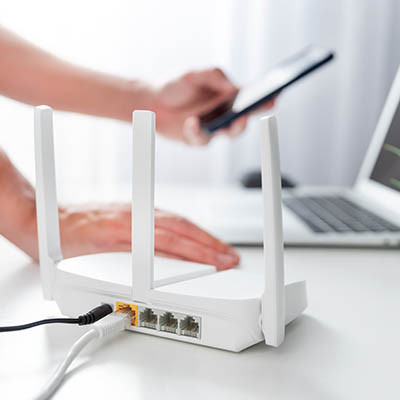
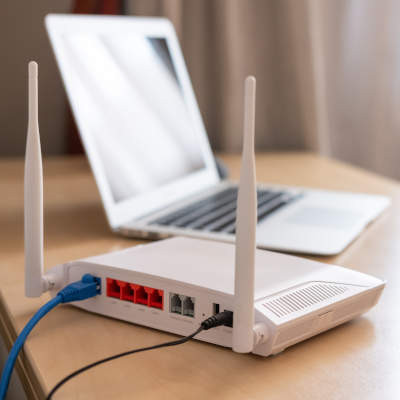
Have you ever thought about why your home Wi-Fi is fantastic in one spot but completely vanishes in another? You might have paid for the fastest internet package and own a brand-new router, yet you still deal with frustrating dead zones and slow connections. It turns out that one of the most crucial elements affecting your speed isn't your internet company or the router itself; it's simply where you decide to place the device.
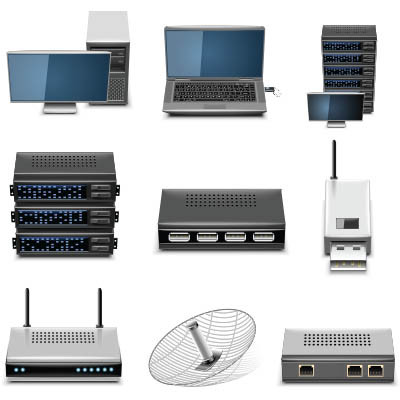
Your network powers your business, so it makes sense that you would want to treat your networking hardware with the respect it deserves. Today, we want to explore some of the common networking solutions out there and how easy it can be to neglect them after the initial setup. Furthermore, we want to emphasize the importance of treating your networking as a priority; remember, your business runs on its network, and if it’s not performing well, all other areas of your business will suffer.
Wi-Fi is everywhere, and only when it’s not available (and you’re in a location where you cannot get cell service) do we realize just how much of a luxury it is to have a solid connection. You can give your team the solid wireless connection it deserves by carefully selecting where you place your organization’s router. Here are a few tips you can consider when placing your office’s wireless router.
Your business runs on its network, and when your network hardware isn’t running up to speed, it can have a significant impact on business operations. It’s also far from the most interesting topic, and other parts of your business—like the software that makes and manages the products or services you provide—likely takes up the spotlight. Here are some of the common networking solutions that are often neglected and why they should be a priority instead.
Few things grind productivity (and patience) to a halt faster than unreliable Wi-Fi. Whether it's a dropped video call during a critical meeting, slow file transfers delaying projects, or frustrating dead zones in your office, poor Wi-Fi isn't just an annoyance; it's often a direct hit to the bottom line. Let’s unpack why Wi-Fi is so important and what you can do about it.
Any business that depends on its IT—in other words, most businesses—needs to consider the cybersecurity that is in place to protect it. Today, many businesses have started focusing their cybersecurity efforts on protecting their network from the edges, an approach that is fittingly known as edge security. Let’s take a moment to talk about the benefits that edge security can offer you.
Sometimes you might encounter situations where your network is limited in the amount of data it can process at any given time. The unfortunate truth is that it can be difficult to identify exactly what the problem is that is causing the slowdown, but one of the most common issues—the network bottleneck—is a pretty safe bet. But what exactly is a bottleneck, and what can be done to solve it?
2020 was a contentious—and for the wireless industry, momentous—year. Marking the official start of 5G networks, 2020’s events amongst mobile providers helped to reinvigorate an industry, while making some considerable shifts in the balance. Let’s consider some of these changes, and how the industry will continue to change for some time moving forward as 5G continues to grow.
Data is one of a business’ most important assets, and as such, it needs to be kept in such a way that it remains organized and utilizable. This has led to widespread use of databases in businesses, which has necessitated the use of database management systems. Let’s take a closer look at these systems, and why they are so crucial.
Businesses require a lot of their Internet connections, especially if they’re using technologies like VoIP, screen-sharing, and/or webinar platforms. If you’re looking to incorporate these features, you need to be sure you have enough bandwidth to support them. We’re looking at a few reasons that your bandwidth matters, and how to tell if you have enough for your needs.
A server is a necessary component of any business’ IT infrastructure, as its job is to make sure that information and policies are distributed the way they need to be across a network. Once, servers had to be on-site in order to work, there is now the option to have a cloud-hosted virtualized server. Which of these is right for your needs? Let’s do a quick comparison to find out.